Robert Indiana Pop Art Robert Indiana Pop Art What Is Made of
Robert Indiana, a towering figure in the American Pop art movement whose LOVE sculpture became one of the most reproduced works of art of the Modern era, has died at the age of 89.
Indiana, whose real last name was Clark, was already enjoying critical and market place success when he debuted hisLOVE series at the Stable Gallery in New York in 1964. That same year, Indiana's piece of work was shown alongside that of Andy Warhol at the Globe's Off-white in Queens.
But that unproblematic, four-alphabetic character sculpture would go on to overshadow the residuum of the artist's oeuvre and prompted some critics to dismiss him as a one-play a joke on pony. Indeed, the fact that this image made him world-famous was something of a double-edged sword. While LOVE was reproduced on 330 million postage stamps, allowing Indiana's fine art to travel the world, it was also reconfigured in countless other forms that he never authorized—or profited from.
His lawyer told theNew York Timesthat Indiana died on Saturday of respiratory failure. Just i day earlier, a company that had worked with Indiana for years filed a lawsuit against a competing fine art seller and the artist'south caretaker for allegedly isolating the artist and producing unauthorized reproductions of his work.
Despite the ubiquity of his most famous epitome, Indiana has been an elusive figure in the fine art globe for decades. In 1978, disillusioned with the New York fine art globe—and the harsh and unfavorable reviews he was receiving—he retreated to Vinalhaven, an island off the coast of Maine, which is only reachable via an hour-long ferry ride.
Indiana'southward fortunes began to change in the past 2 decades, thanks in function to the tireless efforts of his art dealers. A moving ridge of exhibitions helped augment the public'south understanding of Indiana's work, which included far darker interpretations of the American dream. In the 1960s, he created diamond-shaped paintings with the words "Consume" or "Die," likewise as works inspired by the Civil Rights movement.
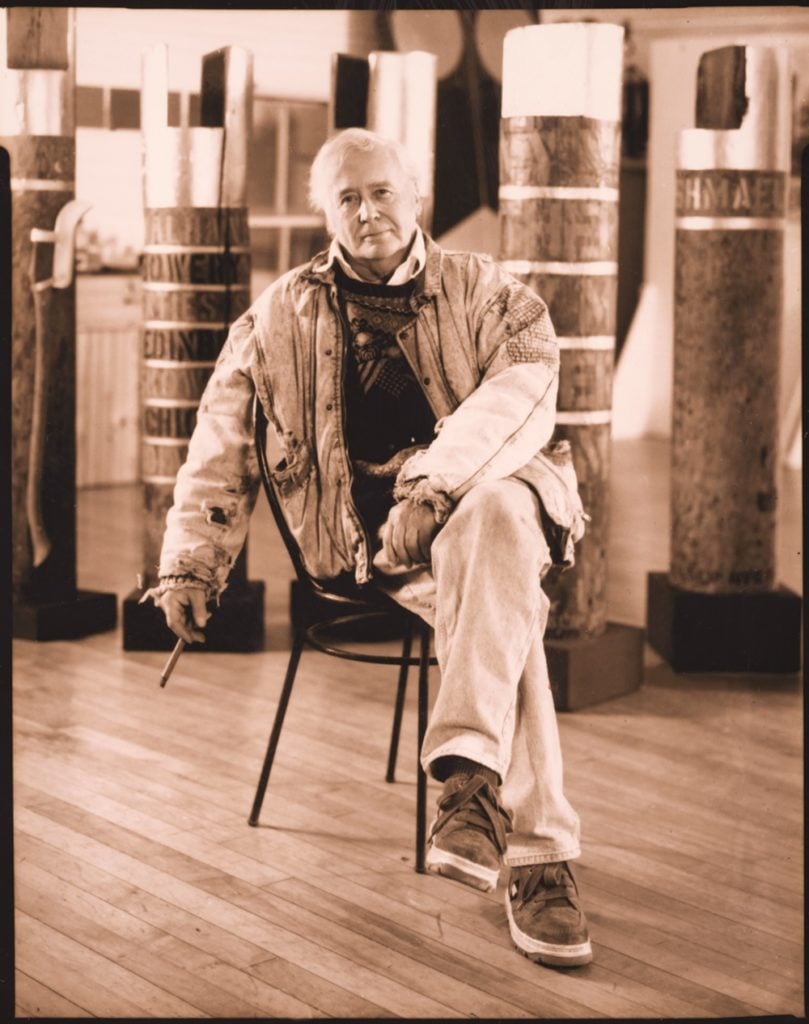
Robert Indiana in his studio, Vinalhaven, Maine. Photograph courtesy of Dennis and Diane Griggs.
These shows helped boost both disquisitional and popular attention as well as sales (a boon for Indiana, who reportedly only received $1,000 for designing the LOVEstamp and did not bother to trademark the image when he first created information technology). They likewise helped him secure prestigious public art commissions in Midtown Manhattan and elsewhere.
Somewhen, Indiana himself seemed to take a more sanguine view of the LOVEimagery that made him and so famous, reportedly assembling a massive collection of tchotchkes and knockoffs inspired by the logo. Earlier dealers and licensing agents sought to pursue infringers and greenbacks in on the epitome in the '90s, he had been unable to capitalize on the millions of mugs, keychains, and trinkets for which he was sometimes unwittingly branded a sellout.
His revived career culminated with a major and aptly titled retrospective "Beyond Dearest" at the Whitney Museum of American Fine art in 2013. "His paintings are gateways between the visual and the exact, the private and the public, the physical and the metaphysical, and the conscious and the unconscious," Ken Johnson wrote in a review of the exhibition. "Richly ambiguous, they unsettle fixed categories. And they are ravishing to behold."
News of the artist'southward death comes at a moment of detail tumult for Indiana and his legacy. Friends and colleagues had recently grown then concerned about their inability to reach Indiana that they had alerted local government, according to Luke Nikas, an attorney for a fine art visitor that filed a lawsuit against Indiana's caretaker and a competing art seller.

Robert Indiana'southward Beloved. Photo: Wikipedia.
On Friday—1 day before Indiana'due south decease—the Morgan Art Foundation, which has worked with the artist for more than than 25 years and funded production of his work, filed a federal lawsuit targeting art seller Michael McKenzie, his editions company American Paradigm Art, the creative person'due south caretaker Jamie Thomas, and Indiana himself.
Their complaint alleges that McKenzie and Thomas had commandeered Indiana's phone and email account in recent years, ultimately cut off straight advice between the elderly artist and his friends and colleagues. The foundation'due south advisor Simon Salama-Caro and his son, Marc, became alarmed when, upon attempting to visit or communicate with him, they received profanity-laced messages telling them to "F**K OFF" or that Indiana did not want to receive visitors, according to the complaint, a copy of which was obtained by artnet News.
The New York Times reported that attempts to reach Indiana at his residence in Vinalhaven—an 1870s-built social club known as the Star of Hope that was formerly used past an international fraternal organization known equally the Independent Guild of Odd Fellows—had been unsuccessful.
Nikas told artnet News that he reported the declared exploitation to local authorities on Fri, at the same time the lawsuit was filed. In response to the suit, McKenzie told the Times: "Bob does not desire to see everyone. He just feels, like, 'I am old, I demand to eat a lot of soup. I am trying to keep it together.'"
The lawsuit too alleges that McKenzie and Thomas have been overseeing the production and distribution of unauthorized works and even fakes. The Morgan Fine art Foundation Limited, a company listed in the Bahamas, has sued the pair for copyright infringement, violation of the Visual Artists Rights Act, defamation, breach of contract, and other claims.
Before today, McKenzie told artnet News via email: "Numerous counterclaims will be filed and nosotros volition have more to say shortly." His attorney did non respond to a request for comment past publication fourth dimension.
"The sad news of Indiana's death just underscores the importance of the litigation and what it seeks to accomplish as the art globe rightfully examines the considerable contributions Indiana made through his life's work," Nikas told artnet News.
Ahead of the creative person's Whitney retrospective, this reporter spoke with American art expert John Wilmerding near Indiana's life and work. When the Dearestsculpture was showtime exhibited, Wilmerding recalled, "It had such originality with its tipped 'O' and this radical kind of punch. Nobody had seen a give-and-take treated equally a block earlier."
Of the fact that the epitome eventually overshadowed and at to the lowest degree temporarily dampened Indiana's legacy, Wilmerding added: "It remains the dandy central paradox of his career."
UPDATE:A previous version of this article incorrectly stated that the lawsuit over the allegedly unauthorized reproduction of Indiana's work had been filed by the Morgan Art Foundation's advisor Simon Salama-Caro and his son, Marc. The lawsuit was in fact filed by the Morgan Art Foundation itself.
Follow Artnet News on Facebook:
Desire to stay ahead of the fine art globe? Subscribe to our newsletter to go the breaking news, eye-opening interviews, and incisive critical takes that drive the conversation forward.
martinsholexpeetry.blogspot.com
Source: https://news.artnet.com/art-world/pop-art-hero-robert-indiana-dies-at-89-1289993
0 Response to "Robert Indiana Pop Art Robert Indiana Pop Art What Is Made of"
Postar um comentário